

Enterprise Wi-Fi is no longer just about providing internet access; it is a critical operational backbone that dictates productivity, security, and employee satisfaction. According to recent industry data, businesses that implement robust managed wireless networks see a significant reduction in IT support tickets and a measurable increase in workforce efficiency. When employees experience seamless connectivity, they can collaborate without interruption, directly impacting revenue and operational growth. This guide details the architectural, security, and management layers required to deploy a professional-grade Wi-Fi solution for your commercial environment.
Understanding Managed Wi-Fi vs. Standard Solutions
Managed Wi-Fi refers to a comprehensive approach where a third-party expert oversees the design, deployment, and ongoing maintenance of your wireless network infrastructure. Unlike consumer-grade routers or basic small business setups, managed solutions offer centralized control, advanced security protocols, and guaranteed uptime. Managed Wi-Fi is a service model where external experts handle the entire lifecycle of your network hardware and software. This ensures that your business benefits from enterprise-grade performance without the burden of internal technical expertise.
Standard Wi-Fi solutions often lack the ability to scale or secure sensitive data effectively. In contrast, managed networks provide real-time analytics, allowing IT administrators to monitor bandwidth usage, identify bottlenecks, and prevent security breaches before they impact operations. For businesses in Montana, Texas, and Colorado, relying on a local provider like Moore Technology ensures that support is not just remote but physically accessible when hardware interventions are required.
Infrastructure Planning and Structured Cabling
The foundation of any high-performance Wi-Fi network is its physical infrastructure. Wireless signals must be delivered to access points via robust wired connections. Poor cabling can bottleneck even the most advanced wireless technology, leading to latency and dropped connections.
Cat6 and Fiber Optic Requirements
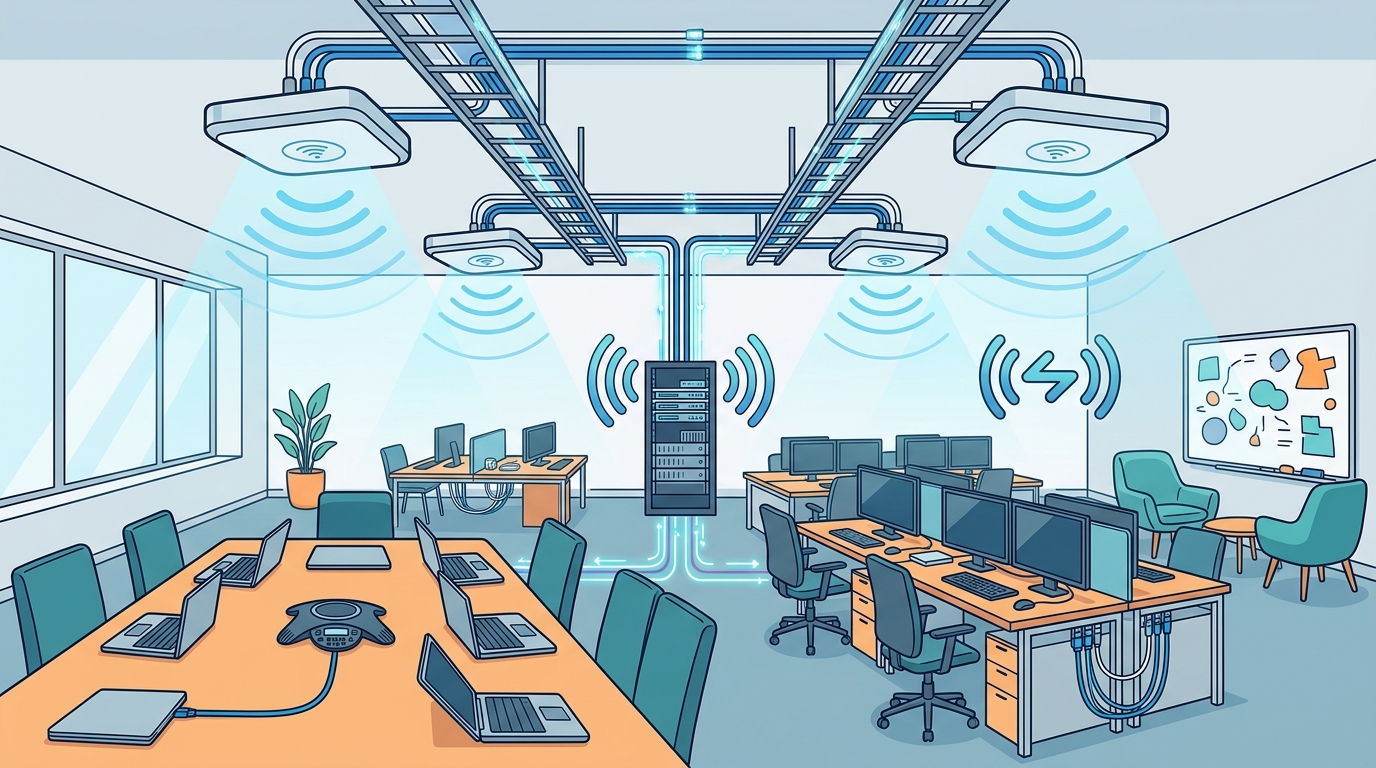
Structured cabling is the backbone of your commercial network. Structured cabling is the organized system of cables and hardware that connects your business devices to the internet and each other. For modern Wi-Fi deployments, Cat6 Ethernet cabling is the standard for most access points due to its ability to support high-speed data transfer and Power over Ethernet (PoE). PoE allows the network switch to deliver both data and electrical power to the access points through a single cable, simplifying installation and reducing the need for separate power outlets.
In larger facilities or for long-distance runs, fiber optic cabling is essential. Fiber provides higher bandwidth and is immune to electromagnetic interference, which is crucial in industrial environments. Moore Technology specializes in designing and installing comprehensive commercial communication systems, ensuring that your cabling infrastructure meets the highest industry standards. Learn more about our Managed IT services to understand how we support your network's physical layer.
Strategic Access Point Placement
Proper placement of wireless access points (APs) is critical for eliminating dead zones and ensuring consistent signal strength. A professional site survey analyzes the physical layout of your office, including walls, floors, and potential sources of interference. APs should be positioned centrally in high-traffic areas and mounted at optimal heights to maximize coverage. Overlapping signals between adjacent APs ensure seamless roaming, allowing employees to move between floors or rooms without losing connectivity.
Security Integration and Access Control
Security is the most critical component of any business network. A managed Wi-Fi solution must integrate seamlessly with your broader security infrastructure to protect sensitive data and prevent unauthorized access.
Network Segmentation for Guest and Staff
Network segmentation involves dividing your network into separate subnetworks to isolate traffic. This ensures that guest users cannot access your internal servers, databases, or employee workstations. By creating a distinct VLAN (Virtual Local Area Network) for guests, you limit their access to the internet only, while your staff retains full access to internal resources. This separation is vital for maintaining compliance with data protection regulations and reducing the risk of internal threats.
Authentication Methods and Biometrics
Advanced authentication methods add an extra layer of security to your Wi-Fi network. Instead of simple password entry, consider implementing access control systems that integrate with your Wi-Fi. This can include keycard systems, biometric scanners, or smartphone-based access. These methods ensure that only authorized personnel can connect to your secure network. Furthermore, integrating your Wi-Fi with your intrusion alarm systems can provide real-time alerts if unauthorized devices attempt to connect.
The Role of Managed IT Services
Deploying the hardware is only half the battle. Ongoing management is required to keep your network secure, efficient, and up-to-date. Managed IT services provide continuous monitoring, patch management, and technical support.
Remote Monitoring and Proactive Maintenance
Proactive maintenance involves monitoring your network 24/7 to identify and resolve issues before they impact your business. Remote technicians can diagnose problems, update firmware, and adjust configurations without needing to be on-site. This level of support is crucial for businesses that rely on constant connectivity. Moore Technology offers complete IT support and cyber security services, ensuring that your Wi-Fi network remains resilient against evolving threats.
Scalability and Multi-Site Management
As your business grows, your network must scale accordingly. A managed Wi-Fi solution should allow for easy addition of new access points, users, and devices without disrupting existing operations. For multi-site businesses, centralized management platforms enable administrators to monitor and configure all locations from a single dashboard. This simplifies IT management and ensures consistent security policies across all branches. Our team has extensive experience managing multi-site deployments for large retail and industrial clients.
Implementation Steps for Your Business
Implementing a managed Wi-Fi solution requires careful planning and execution. Follow these steps to ensure a successful deployment.
Conducting a Professional Site Survey
The first step is to conduct a thorough site survey. This involves mapping your physical space, identifying potential interference sources, and determining the optimal number and placement of access points. A professional survey ensures that your network design meets your specific coverage and capacity requirements. Moore Technology provides expert installation of structured cabling solutions and network installations tailored to your business needs.
Hardware Installation and Configuration
Once the design is finalized, the hardware is installed and configured. This includes mounting access points, running cabling, and configuring network switches. The network is then configured with the appropriate security protocols, VLANs, and management settings. Finally, rigorous testing is performed to ensure that all areas have adequate coverage and that the network performs as expected. Our technicians are fully mobile, ensuring flexibility in service delivery and prompt resolution of any issues.
Key Takeaways
- Managed Wi-Fi provides enterprise-grade performance, security, and support, unlike consumer-grade solutions.
- Structured cabling using Cat6 or fiber optic is the essential foundation for reliable wireless connectivity.
- Network segmentation isolates guest traffic from sensitive internal data, enhancing overall security.
- Proactive monitoring allows IT providers to resolve issues before they impact business operations.
- Scalability is crucial for businesses that plan to expand their workforce or add new locations.
- Integration with access control systems ensures that only authorized personnel can connect to the network.
- Professional site surveys are necessary to eliminate dead zones and optimize access point placement.
Frequently Asked Questions
What is the difference between managed Wi-Fi and standard Wi-Fi?
Managed Wi-Fi includes ongoing support, monitoring, and security updates from a professional provider, whereas standard Wi-Fi relies on internal staff or consumer-grade hardware with limited support.
How often should I update my Wi-Fi firmware?
Firmware should be updated regularly, typically every few months, to patch security vulnerabilities and improve performance. Managed IT services handle these updates automatically.
Can I integrate my Wi-Fi with my existing security cameras?
Yes, modern Wi-Fi networks can be segmented to support IoT devices like security cameras without compromising the main network's performance or security.
What is Power over Ethernet (PoE)?
PoE is a technology that allows electrical power and data to be transmitted to devices like access points over a single Ethernet cable, simplifying installation.
How does Moore Technology support multi-site businesses?
We provide centralized management platforms that allow you to monitor and configure all your locations from a single dashboard, ensuring consistency and efficiency.
What is a site survey?
A site survey is a professional assessment of your physical space to determine the optimal placement of network hardware for maximum coverage and performance.
Is managed Wi-Fi secure?
Yes, managed Wi-Fi solutions include advanced security features like encryption, network segmentation, and real-time threat monitoring to protect your data.
Contact Moore Technology for Your Wi-Fi Solution
Ready to upgrade your business network? Moore Technology offers comprehensive IT support, structured cabling, and security solutions tailored to your needs. Contact us today to schedule a consultation and discover how we can enhance your connectivity. Visit our contact page or call (406) 284-8324 to get started.