

How to Evaluate a Vendor for Cyber Security and Alarm Maintenance
Choosing the right partner for multi-site security and IT maintenance requires a rigorous evaluation of their operational capabilities. You must verify their ability to manage both digital and physical assets consistently across different geographies. This guide outlines the specific criteria for assessing vendor reliability, technical depth, and service continuity. It covers preventive maintenance procedures, response protocols, and reporting standards. We focus on how to ensure your infrastructure remains secure and functional without constant oversight. For additional details, review the mooretech biz.
Preventive Maintenance Procedures
Preventive maintenance is the systematic inspection and servicing of equipment to prevent unexpected failures. It shifts the focus from reactive repairs to proactive stability. For a business with multiple locations, this approach reduces downtime and extends the lifespan of critical hardware. You need a vendor who treats maintenance as a scheduled discipline, not an afterthought. For additional details, review the .
Physical Security System Inspections
Cyber Infrastructure Health Checks
Documentation and Reporting
Every maintenance visit must generate a clear report. This document should detail what was tested, what was found, and what actions were taken. You should receive a summary that highlights any recurring issues or recommended upgrades. Clear documentation allows your internal team to track the health of your assets over time. For additional details, review the Customer Experience.
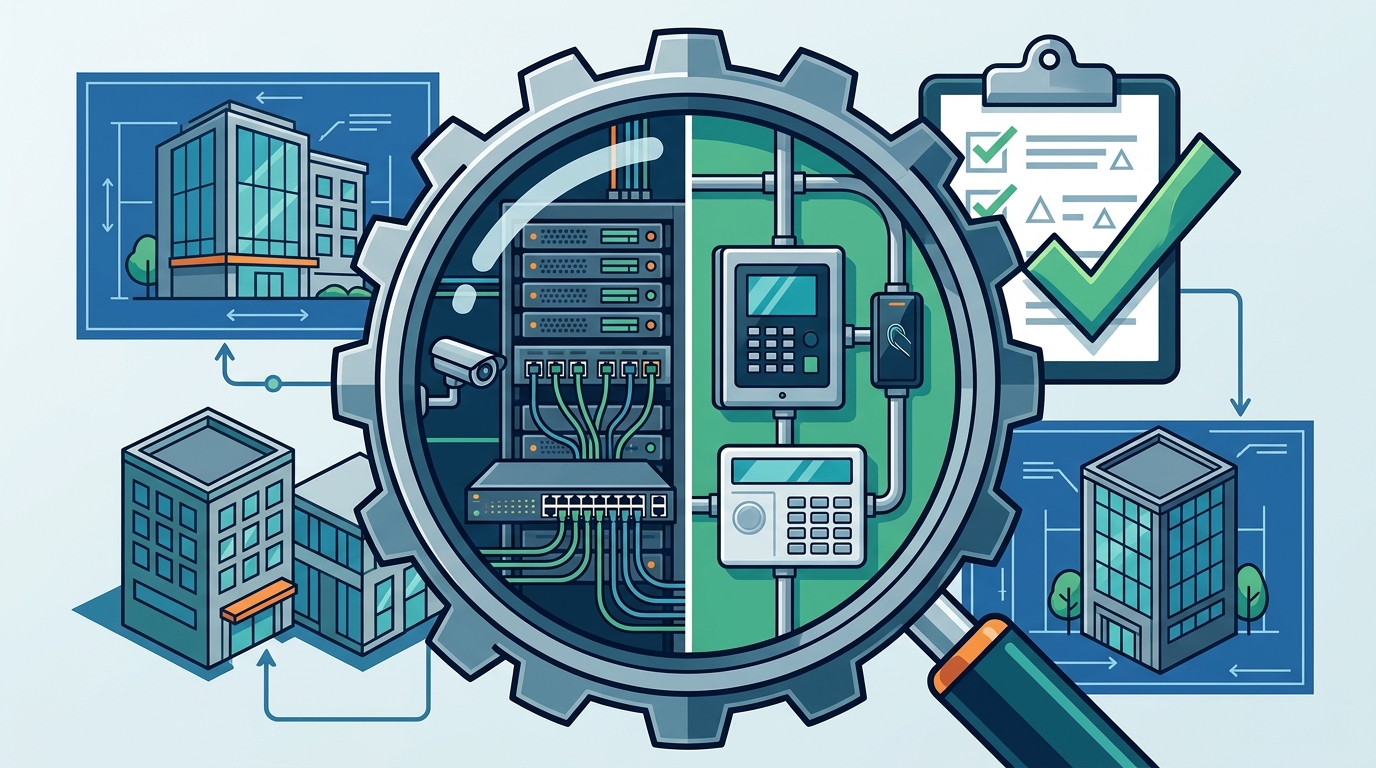
Ensuring Multi-Site Consistency
Managing security across multiple locations demands a standardized approach. Inconsistency between sites creates gaps that attackers can exploit. A qualified vendor must apply the same rigorous standards to every location, regardless of size or geography. This consistency ensures that your security posture is uniform and predictable. For additional details, review the Frequently Asked Questions.
Standardized Service Level Agreements
Geographic Coverage and Logistics
Centralized Monitoring and Management
Effective multi-site management relies on centralized visibility. The vendor should provide a dashboard that aggregates data from all locations. This allows you to monitor the status of alarms, network health, and access events from a single interface. Centralized management reduces the administrative burden on your internal team. For additional details, review the About.
Integrating Cyber and Physical Security
Cyber security is the protection of digital assets from unauthorized access and damage. Physical security is the protection of tangible assets and personnel from physical threats. In modern environments, these two domains are deeply interconnected. A camera system is a network device. An access control panel is a software endpoint. Treating them as separate silos creates blind spots.
Converged Infrastructure Risks
When physical security devices connect to your corporate network, they become part of your attack surface. A compromised camera can serve as a foothold for lateral movement into sensitive systems. Your vendor must understand this convergence and implement appropriate network segmentation. This isolation prevents a breach in one domain from cascading into the other.
Unified Incident Response
Incident response plans must cover both cyber and physical events. A physical intrusion may trigger a cyber investigation, and a cyber attack may disable physical alarms. Your vendor should have a unified protocol for handling such events. This ensures that all relevant teams are alerted and coordinated during a crisis.
Vendor Expertise in Both Domains
Not all IT providers understand physical security, and not all security firms understand IT. You need a partner with deep expertise in both areas. This dual competency ensures that solutions are designed with the full picture in mind. It prevents conflicts between network policies and security hardware requirements.
Key Vendor Evaluation Metrics
Evaluating a vendor requires looking beyond marketing claims. You must assess their operational maturity and technical depth. Use specific metrics to gauge their capability. These metrics provide objective data points for comparison.
Response and Resolution Times
Measure how quickly the vendor acknowledges and resolves issues. Track the average time to acknowledge a ticket and the average time to resolve it. Compare these metrics against your SLAs. Consistent performance across all sites indicates a stable operation.
Proactive vs. Reactive Ratio
Analyze the ratio of proactive maintenance to reactive repairs. A healthy vendor should spend the majority of their time on preventive tasks. A high ratio of reactive fixes suggests underlying instability or poor planning. This metric reveals the true health of your infrastructure.
Communication and Transparency
Assess the quality of communication from the vendor. Do they provide regular status updates? Are their reports clear and actionable? Transparency builds trust and ensures you are never left in the dark. Poor communication is a leading indicator of future service failures.
Vendor Capability Comparison
The following table summarizes the key capabilities to look for in a vendor. Use this as a checklist during your evaluation process.
| Capability Area | Essential Requirement | Why It Matters |
|---|---|---|
| Preventive Maintenance | Scheduled on-site and remote checks | Prevents unexpected failures and extends hardware life |
| Multi-Site Consistency | Unified SLAs and standardized procedures | Ensures uniform security posture across all locations |
| Cyber-Physical Integration | Network segmentation and unified monitoring | Reduces attack surface and improves incident response |
| Reporting | Automated dashboards and detailed logs | Provides visibility and accountability for all activities |
| Geographic Reach | Local technicians or reliable travel protocols | Ensures prompt physical access for maintenance and repairs |
Key Takeaways
- Preventive maintenance is a systematic process that prevents failures before they occur.
- Multi-site operations require standardized SLAs and consistent procedures across all locations.
- Cyber and physical security are interconnected and must be managed as a unified system.
- Network segmentation is critical to prevent breaches from spreading between domains.
- Vendor communication quality is a strong indicator of overall service reliability.
- Centralized monitoring reduces administrative burden and improves visibility.
- Regular audits of vendor performance against SLAs ensure accountability.
- Choose a vendor with proven expertise in both IT and physical security domains.
Frequently Asked Questions
What is the difference between reactive and preventive maintenance?
Reactive maintenance involves fixing issues after they occur. Preventive maintenance involves scheduled inspections and servicing to prevent issues before they happen. Preventive maintenance is generally more cost-effective and reliable.
How often should physical security systems be inspected?
Physical security systems should be inspected at least annually, with more frequent checks for high-risk areas. The specific frequency depends on the type of equipment and local regulations.
Can a single vendor manage both IT and physical security?
What should be included in a vendor's SLA?
An SLA should specify response times, resolution targets, uptime commitments, and reporting requirements. It should also outline penalties for non-performance and escalation procedures.
How do I measure vendor performance?
Measure vendor performance by tracking key metrics such as response times, resolution rates, and the ratio of proactive to reactive work. Regular reviews of these metrics ensure accountability.
Why is network segmentation important for security systems?
Network segmentation isolates security devices from the rest of the network. This limits the potential impact of a breach and prevents attackers from moving laterally into sensitive systems.
What are the risks of using separate vendors for IT and security?
Using separate vendors can lead to communication gaps and inconsistent policies. This can create blind spots in your security posture and complicate incident response.