

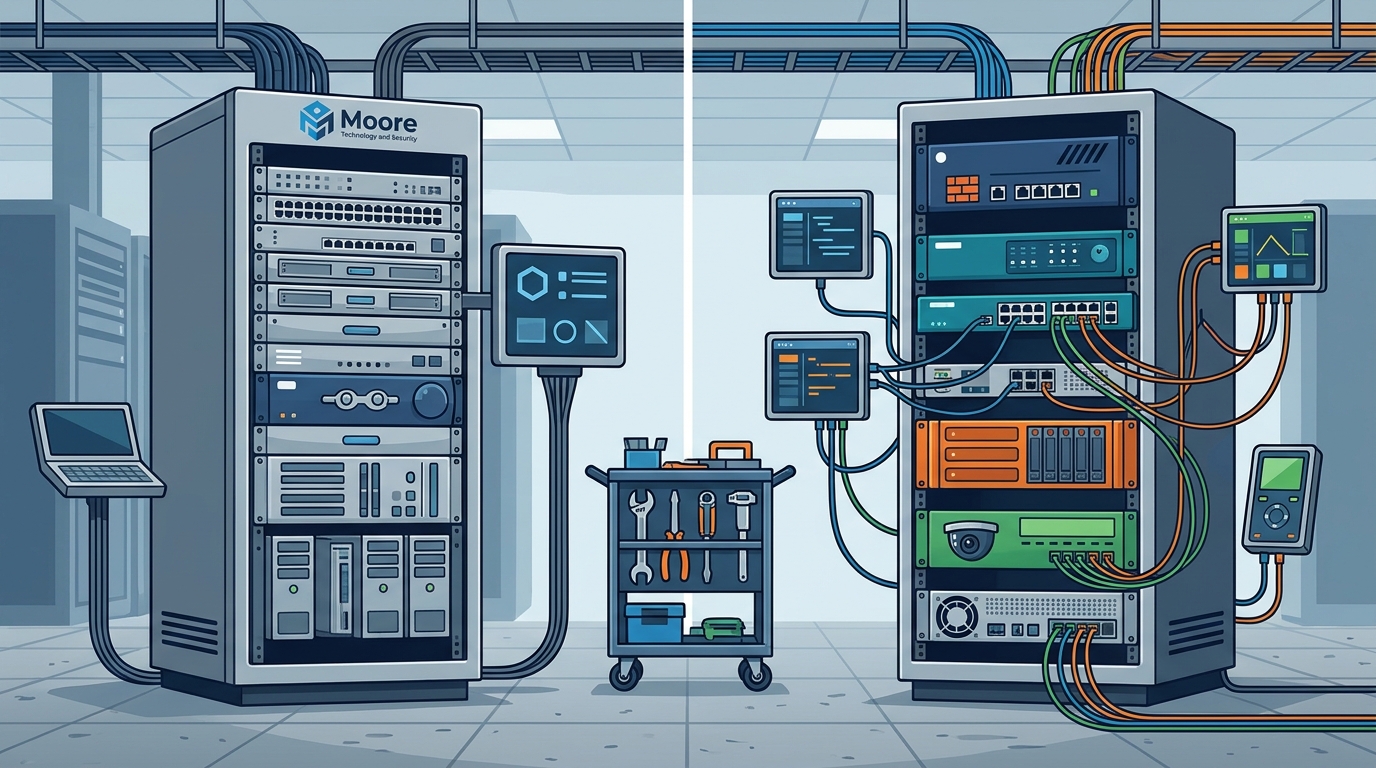
Choosing between a single-vendor and a best-of-breed strategy is a critical decision for businesses managing complex technology stacks. Single-vendor maintenance is a model where one provider manages all hardware, software, and security systems under a unified contract. Best-of-breed maintenance is an approach where a business selects the top-performing vendor for each specific technology category. Managed IT services is the professional practice of overseeing these systems to ensure reliability and security. At Moore Technology and Security, we help commercial and industrial clients in Montana, Texas, and Colorado navigate these choices to build resilient infrastructure.
1. Accountability and Support Channels
2. Cost Structure and Budgeting
3. Technical Expertise and Specialization
4. System Integration and Compatibility
Single-vendor approaches naturally promote tighter integration between different technology layers. When one company installs your network and your access control system, they design them to communicate efficiently. This reduces compatibility issues and configuration conflicts. Best-of-breed systems require robust integration work to ensure that disparate products talk to each other. This often involves additional middleware or custom development, which can introduce new points of failure.
5. Vendor Lock-In and Flexibility
6. Risk Management and Redundancy
Best-of-breed strategies can mitigate risk by avoiding dependence on a single provider's financial health. If one vendor goes out of business, you only lose that specific component. Single-vendor models concentrate risk, as a provider's failure could impact all your critical systems. However, a single provider can implement unified security policies that reduce attack surface. At Moore Technology and Security, we focus on building resilient systems that protect your data and property regardless of the maintenance model you choose.
7. Scalability and Growth Alignment
Single-vendor providers can scale your infrastructure more cohesively as your business grows. They can plan for capacity across all systems simultaneously, ensuring balanced growth. Best-of-breed requires coordinating scaling efforts across multiple vendors, which can lead to uneven capacity. This may result in bottlenecks where one system outpaces another. A unified approach ensures that your network, security, and IT resources expand in harmony with your business needs.
Choosing the Right Approach
Frequently Asked Questions
What is the main advantage of a single-vendor IT model?
The main advantage is simplified accountability and integration. One provider manages all systems, reducing communication overhead and ensuring components work together seamlessly.
Is best-of-breed more expensive than single-vendor?
Can a single vendor handle both physical and digital security?
Yes, many managed IT providers, such as Moore Technology and Security, specialize in integrating physical security systems like cameras and access control with digital IT infrastructure.
How do I switch from single-vendor to best-of-breed?
Transitioning requires careful planning to ensure data migration and system compatibility. You must audit your current contracts and identify which components to replace with specialized vendors.
Does Moore Technology and Security offer both models?
Moore Technology and Security provides managed IT and security services that can be tailored to fit either a unified or hybrid approach, depending on your specific business needs.
Conclusion
Both single-vendor and best-of-breed approaches have distinct advantages and trade-offs. The right choice depends on your specific operational needs, budget, and risk profile. Moore Technology and Security is ready to help you evaluate your current infrastructure and design a maintenance strategy that protects your business. Contact our team today to discuss your technology needs. Learn more: mooretech biz.