

Modern businesses are rapidly shifting from legacy on-premise storage to cloud-based video management systems (VMS). This transition is not merely a trend but a structural necessity for operational resilience. According to recent industry data, the cloud surveillance market is projected to grow at a compound annual growth rate of over 20% through 2026. This surge is driven by the need for scalable, remote-accessible security infrastructure that eliminates the physical limitations of traditional digital video recorders (DVRs) and network video recorders (NVRs). For commercial entities, the challenge lies not in adopting the cloud, but in seamlessly bridging it with existing network hardware without compromising bandwidth or security. (About Us 8902 Moore)
Understanding Cloud-Based Surveillance Architecture
Cloud-based surveillance refers to a security infrastructure where video data is transmitted over the internet to remote servers for storage, processing, and retrieval. Unlike traditional systems that rely on local hard drives, cloud systems offer virtually unlimited scalability. This architecture allows security teams to monitor live feeds and review historical footage from any device with internet access. The core benefit is business continuity; if a physical camera or local server is damaged, the data remains safe in the cloud.
However, this model introduces significant demands on your existing network. Video streams are data-intensive. Integrating them with legacy hardware requires a thorough audit of your current infrastructure to ensure it can handle the increased load without degrading performance for other critical business applications.
Evaluating Existing Network Hardware Compatibility
Before migrating to the cloud, you must assess the capabilities of your current network hardware. Not all devices are created equal, and compatibility issues are the primary cause of integration failure. The following components require careful evaluation.
IP Camera Standards and Protocols
The foundation of any surveillance system is the camera itself. Most modern IP cameras support the ONVIF standard, which ensures interoperability between different manufacturers. If your existing cameras are ONVIF-compliant, they can typically connect to most cloud VMS platforms without proprietary hardware gateways. However, older analog cameras converted to digital via DVRs may not support direct cloud integration. In such cases, you may need to replace the DVR with an NVR that supports cloud uploading or install edge devices that bridge the gap.
Network Switching and Power over Ethernet
Your network switches must support Power over Ethernet (PoE) to power IP cameras efficiently. More importantly, they must have sufficient bandwidth capacity. If you are adding high-definition 4K cameras to a network designed for 1080p, the switch ports may become bottlenecks. Check the switch's backplane bandwidth and forwarding rate. If your current switches are Gigabit Ethernet, they can handle multiple high-resolution streams, but you must calculate the total aggregate bandwidth required for all cameras uploading to the cloud simultaneously.
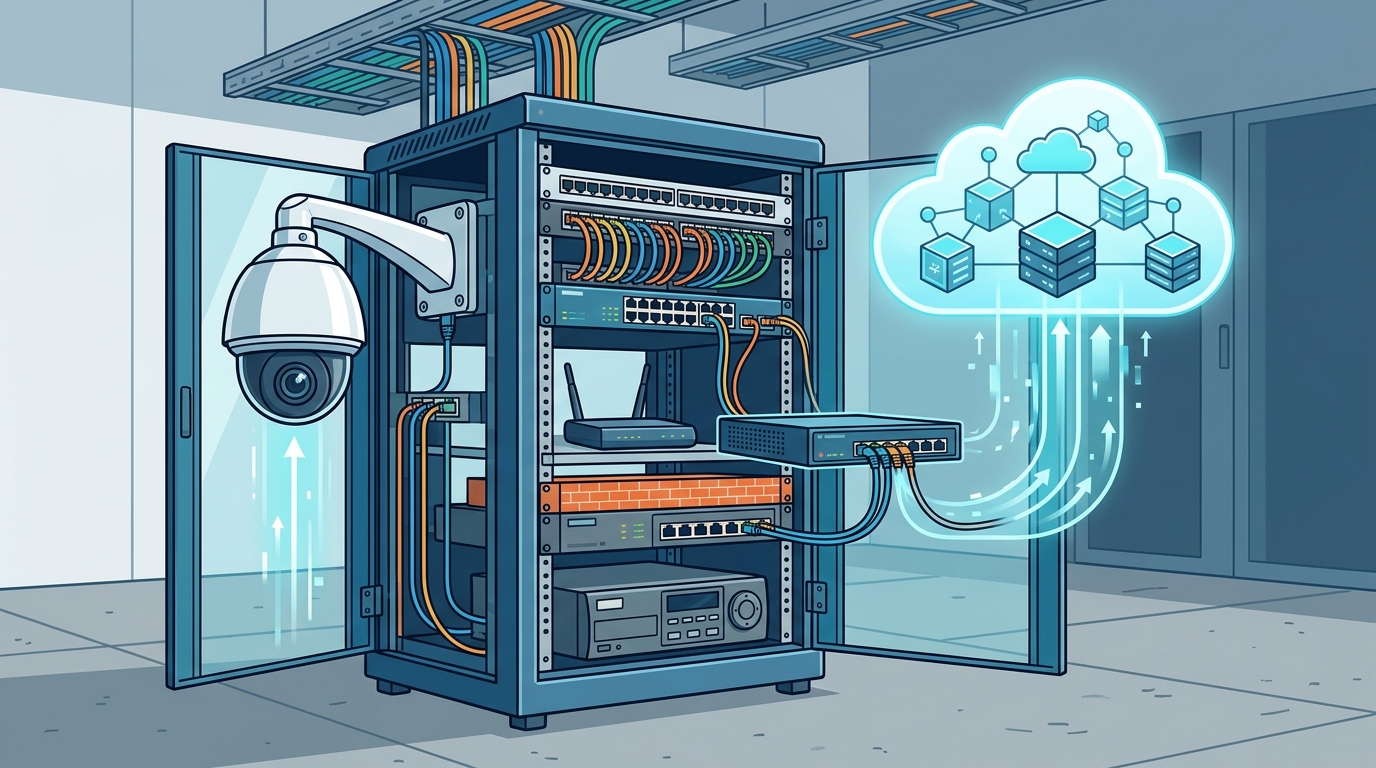
Strategies for Seamless Integration
Integration is not a plug-and-play process. It requires strategic planning to balance data quality with network performance. Moore Technology specializes in designing these hybrid architectures for commercial clients across Montana, Texas, and Colorado.
Leveraging Edge Computing
Edge computing involves processing video data locally on the camera or a nearby edge device before sending it to the cloud. This strategy is critical for reducing bandwidth consumption. Instead of streaming 24/7 high-definition video, edge devices can be configured to send only event-triggered clips or low-resolution previews. This approach ensures that your existing network hardware is not overwhelmed during peak business hours. It also enhances privacy by keeping sensitive raw data on-premise while still providing cloud accessibility for authorized personnel.
Bandwidth Optimization Techniques
To protect your existing network infrastructure, implement strict Quality of Service (QoS) policies. QoS prioritizes video traffic over less critical data, ensuring that surveillance feeds remain stable even during high network usage. Additionally, consider using variable bitrate (VBR) encoding. VBR adjusts the video quality dynamically based on network conditions, preventing spikes in data usage that could disrupt other business operations. Regular network audits are essential to monitor these metrics and adjust configurations as your camera count grows.
Security and Compliance in Hybrid Environments
Integrating cloud surveillance introduces new attack vectors. Your existing network hardware must be hardened to prevent unauthorized access to video streams. This includes updating firmware on all cameras, switches, and routers to the latest versions. Furthermore, ensure that your cloud provider complies with relevant data protection regulations, such as GDPR or CCPA, depending on your location. Moore Technology provides comprehensive managed IT services that include regular security audits and firmware management to keep your hybrid environment secure.
Access control is another critical component. Implement multi-factor authentication (MFA) for all cloud-based VMS accounts. This ensures that only authorized personnel can view or download footage. Additionally, segment your network using VLANs (Virtual Local Area Networks). By isolating surveillance traffic from your main corporate network, you reduce the risk of lateral movement in the event of a cyber attack.
Key Takeaways
- Market Growth: The cloud surveillance market is expanding rapidly, with growth rates exceeding 20% annually through 2026.
- ONVIF Compliance: Ensure existing IP cameras support the ONVIF standard for seamless integration with cloud VMS platforms.
- Edge Computing: Utilize edge devices to process data locally, reducing bandwidth demands on your existing network hardware.
- QoS Policies: Implement Quality of Service rules to prioritize video traffic and prevent network congestion.
- Network Segmentation: Use VLANs to isolate surveillance traffic from corporate data, enhancing overall security.
- Moore Technology Expertise: With over a decade of experience, Moore Technology specializes in complex commercial installations across Montana, Texas, and Colorado.
- Security First: Regular firmware updates and multi-factor authentication are non-negotiable for secure cloud integration.
Frequently Asked Questions
Can I integrate my existing analog cameras with a cloud system?
Direct integration is not possible for analog cameras. You must first convert them to digital using a DVR or NVR that supports cloud uploading. Alternatively, you can replace the analog cameras with IP cameras that natively support cloud connectivity.
How much bandwidth does cloud surveillance require?
Bandwidth requirements depend on the number of cameras, resolution, and frame rate. A single 1080p camera may require 2-4 Mbps, while a 4K camera can require 8-16 Mbps. Edge computing can significantly reduce this by sending only event-based footage to the cloud.
Is cloud surveillance more secure than local storage?
Cloud surveillance offers superior data redundancy and protection against physical theft or damage. However, it requires robust network security measures, such as encryption and multi-factor authentication, to prevent unauthorized access.
What is the role of edge computing in cloud integration?
Edge computing processes video data locally on the camera or a nearby device. This reduces the amount of data sent to the cloud, optimizing bandwidth usage and improving response times for critical events.
Does Moore Technology support nationwide installations?
Yes, Moore Technology provides nationwide installation coverage, with service calls managed from our locations in Montana and Texas. We serve commercial and industrial clients across multiple states.
How do I ensure my existing network switches can handle cloud surveillance?
Check the switch's backplane bandwidth and forwarding rate. Ensure it supports Gigabit Ethernet and sufficient PoE power budget for your cameras. A network audit can help identify potential bottlenecks.
What are the core values of Moore Technology?
Our core values include "Prompt Resolution," "Quality of Work," and "Quality of Life." We prioritize immediate service, personal integrity, and employee well-being to deliver exceptional results.
Partner with Moore Technology for Seamless Integration
Integrating cloud-based surveillance with your existing network hardware is a complex but rewarding endeavor. It requires expert planning, precise configuration, and ongoing management. Moore Technology is your trusted partner in this transition. As a leading managed IT and technology integration company, we specialize in designing and installing comprehensive commercial communication and security systems. Our team of experts ensures that your surveillance infrastructure is secure, scalable, and seamlessly integrated with your business operations.
Don't let legacy hardware hold you back. Contact Moore Technology today to schedule a consultation. We will assess your current infrastructure and design a custom solution that meets your unique needs. Visit our contact page to get started. Let us help you secure your future with confidence.