
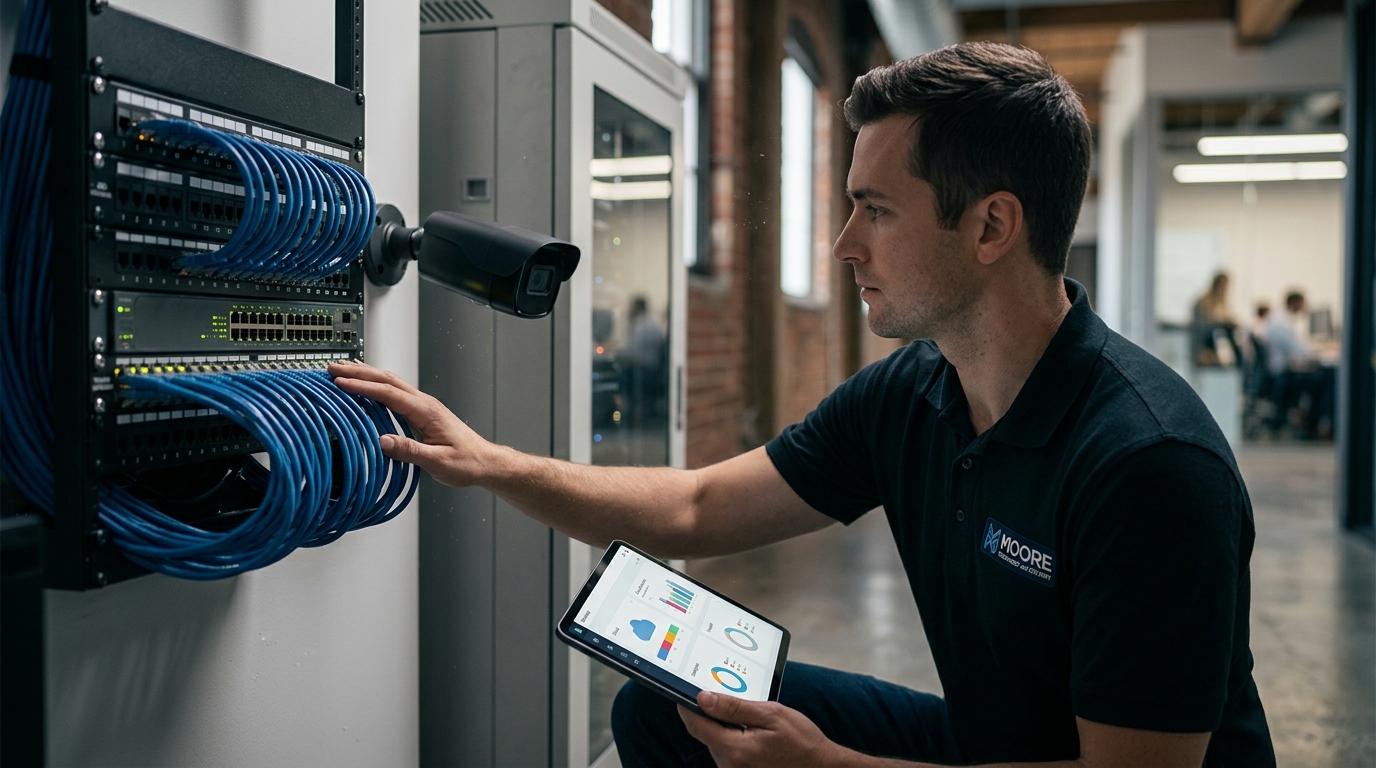
Modern businesses are rapidly shifting from legacy on-premise storage to cloud-based surveillance architectures to reduce hardware costs and improve remote accessibility. According to recent industry data, organizations that successfully migrate to hybrid cloud security models report a 40% reduction in maintenance overhead compared to traditional DVR-based systems. This transition is not merely a software update but a fundamental restructuring of how data flows from physical cameras to secure cloud endpoints. Moore Technology specializes in bridging this gap, ensuring that your existing infrastructure supports modern cloud demands without compromising security or performance.
Understanding Cloud Surveillance Architecture
Cloud surveillance refers to the practice of storing video footage on remote servers accessed via the internet rather than local hard drives. This model eliminates the physical risk of stolen or damaged recording devices. Cloud surveillance is a distributed storage model where video data is encrypted and transmitted to secure off-site servers for long-term retention.
For commercial entities, this shift offers significant advantages. It allows for real-time monitoring from any location, scalable storage that grows with your needs, and automated threat detection powered by artificial intelligence. However, the success of this architecture depends entirely on the robustness of the underlying network. If your current cabling or switching infrastructure cannot handle the bandwidth requirements of high-definition video streams, the cloud integration will fail regardless of the software quality.
Moore Technology provides complete IT support and cyber security services designed to evaluate your current state and plan a seamless migration path. We ensure that your transition to cloud-based monitoring does not disrupt daily operations while enhancing your overall security posture.
Auditing Your Existing Network Hardware
Before integrating any cloud solution, you must conduct a rigorous audit of your existing network hardware. Many older commercial buildings rely on legacy Cat5 cabling or non-PoE (Power over Ethernet) switches that cannot support modern IP cameras. Attempting to force cloud integration on inadequate hardware leads to packet loss, video lag, and system instability.
Evaluating Cabling Standards
Your physical cabling is the backbone of your surveillance system. Structured cabling is the organized system of cables and hardware used to connect telecommunications equipment in commercial buildings. Moore Technology specializes in business networking and cabling services, including the installation of Cat6 and fiber optic networks. These standards provide the necessary bandwidth and shielding to handle continuous 4K video streams without interference.
If your building was wired in the early 2000s, it likely lacks the capacity for modern cloud feeds. Upgrading to Cat6a or fiber optic infrastructure ensures that data travels efficiently from the camera to the network switch and out to the internet gateway.
Switching and Bandwidth Management
Network switches act as the traffic controllers for your surveillance data. You need managed switches that support Quality of Service (QoS) protocols. QoS prioritizes video traffic over other network activities, ensuring that a video stream does not drop during peak business hours. Moore Technology designs network installations that include intelligent traffic management to prevent bottlenecks.
Integration Methods for Legacy Systems
Not every business can afford to replace its entire camera fleet. Fortunately, there are several methods to integrate cloud capabilities with existing hardware. The choice depends on the age of your cameras and your specific security requirements.
Hybrid NVR with Cloud Uploading
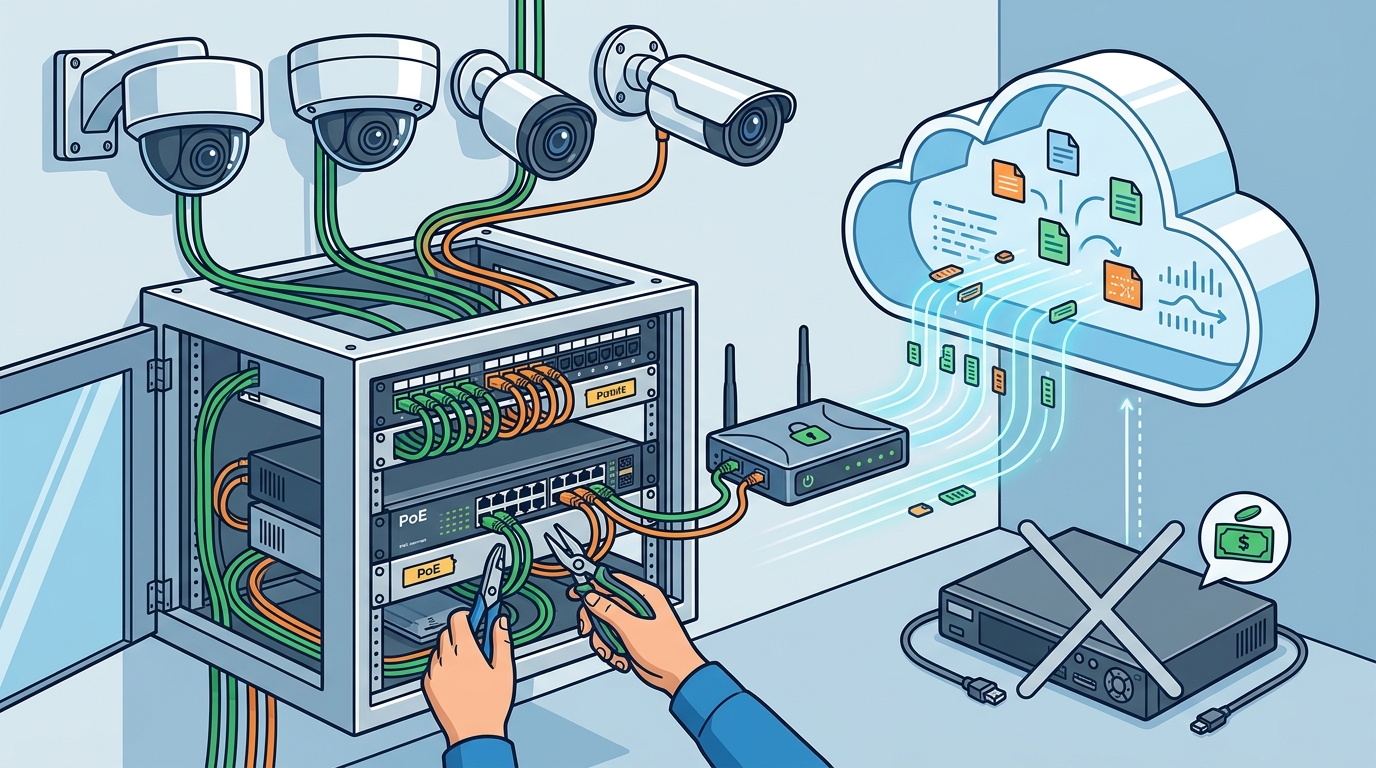
This is the most common approach for businesses with functional IP cameras. A Hybrid Network Video Recorder (NVR) stores footage locally for immediate playback while simultaneously uploading encrypted clips to the cloud. This provides a dual-layer security strategy. If the local hardware is damaged or stolen, the cloud backup remains intact.
Moore Technology offers managed IT services that include the configuration and maintenance of these hybrid systems. We ensure that the upload schedules are optimized to avoid saturating your internet connection during critical business operations.
Video Management Software (VMS) Middleware
For older analog cameras, you can install video encoders that convert analog signals to digital IP streams. These encoders can then connect to a cloud-based VMS platform. This method allows you to retain your existing lenses and camera housings while modernizing the data transmission method. It is a cost-effective way to achieve cloud integration without a full hardware overhaul.
Direct Cloud Camera Replacement
In some cases, the most efficient path is a phased replacement of cameras with native cloud-enabled models. These cameras have built-in Wi-Fi or Ethernet connectivity and direct cloud APIs. Moore Technology handles commercial security camera systems installations, ensuring that new hardware integrates seamlessly with your existing network switches and access control systems.
Security and Compliance in Hybrid Models
Integrating cloud surveillance introduces new security vectors that must be managed carefully. Data in transit and data at rest must be protected against unauthorized access. Cyber security is the practice of protecting systems, networks, and programs from digital attacks that aim to access, change, or destroy sensitive information.
Encryption Standards
Ensure that your cloud provider uses AES-256 encryption for data at rest and TLS 1.3 for data in transit. Moore Technology prioritizes cyber security in all our deployments, verifying that every data packet leaving your premises is encrypted. This prevents interception by malicious actors on public networks.
Access Control Integration
Your surveillance system should not operate in a silo. Integrating cloud video with your access control systems creates a powerful security workflow. When a door is forced open, the system can automatically trigger the nearest camera to record and upload the footage to the cloud in real-time. This联动 (linkage) provides immediate context for security teams and law enforcement.
Regulatory Compliance
Different industries have strict data retention and privacy regulations. For example, healthcare facilities must comply with HIPAA, while financial institutions must adhere to SOX. Moore Technology ensures that your cloud storage locations and data handling procedures meet these regulatory requirements. We provide intrusion alarm systems and monitoring solutions that are compliant with federal and state laws.
Comparison of Integration Options
Choosing the right integration path requires balancing cost, complexity, and performance. The table below outlines the primary options available for commercial businesses.
| Integration Method | Best For | Hardware Requirements | Cloud Capability |
|---|---|---|---|
| Hybrid NVR | Existing IP Camera Networks | Managed Switch, High-Bandwidth Internet | Automatic Backup & Remote Viewing |
| Video Encoders | Legacy Analog Cameras | Analog-to-Digital Encoders, Network Cabling | Full Cloud Migration via VMS |
| Native Cloud Cameras | New Installations or Full Replacements | PoE Switches, Wi-Fi Access Points | Direct API Integration & AI Analytics |
| SD Card Local-Cloud | Small Retail or Remote Sites | Cameras with SD Slots, Cellular Backup | Event-Based Cloud Uploads |
Moore Technology helps you evaluate these options based on your specific business web services and infrastructure needs. We do not believe in one-size-fits-all solutions. Instead, we design custom architectures that maximize your return on investment.
Key Takeaways
- Infrastructure First: Cloud integration fails if the local network cannot handle the bandwidth. Moore Technology specializes in structured cabling to ensure your foundation is solid.
- Hybrid is the Standard: Most businesses benefit from a hybrid model that keeps local storage for speed and cloud storage for disaster recovery.
- Security is Critical: Always verify encryption standards and integrate with access control systems for comprehensive protection.
- Scalability Matters: Cloud solutions allow you to add cameras without buying more hard drives. Moore Technology provides mobile surveillance towers and scalable IT support for growing businesses.
- Expert Installation: Proper configuration of QoS and VLANs is essential. Moore Technology’s technicians ensure your network installations are optimized for video traffic.
- Compliance Assurance: Ensure your cloud provider meets industry-specific regulations. Moore Technology offers commercial security camera systems that are compliant with federal standards.
- Local Support: Moore Technology provides prompt, local support in Montana, Texas, and Colorado, ensuring rapid response to any technical issues.
Frequently Asked Questions
Can I integrate cloud surveillance with my old analog cameras?
Yes, you can use video encoders to convert analog signals to digital IP streams, which can then be connected to a cloud-based Video Management System (VMS). Moore Technology provides business networking and cabling services to facilitate this transition.
How much bandwidth does cloud surveillance require?
Bandwidth requirements depend on the number of cameras, resolution, and frame rate. A single 4K camera may require 8-16 Mbps. Moore Technology performs detailed IT support audits to calculate your exact needs and recommend appropriate internet upgrades.
Is cloud surveillance secure from hackers?
Cloud surveillance is secure when implemented with strong encryption and multi-factor authentication. Moore Technology prioritizes cyber security by ensuring all data is encrypted in transit and at rest, and by integrating with robust access control systems.
What happens if my internet goes down?
In a hybrid setup, footage continues to be recorded locally on the NVR. Once the internet is restored, the system uploads the missed footage to the cloud. Moore Technology offers intrusion alarm systems and monitoring that include internet failover solutions.
Does Moore Technology offer remote monitoring services?
Yes, Moore Technology provides complete IT support and cyber security services, including remote monitoring and management of your cloud surveillance infrastructure from our offices in Montana and Texas.
How long is footage stored in the cloud?
Retention periods vary by provider and plan, typically ranging from 7 to 90 days. Moore Technology helps you select a plan that balances cost with your regulatory and operational needs.
Can I access my cloud footage from my phone?
Yes, most modern cloud surveillance platforms offer mobile apps for iOS and Android. Moore Technology ensures that your commercial security camera systems are configured for seamless mobile access.
Partner with Moore Technology
Integrating cloud-based surveillance with your existing network hardware is a strategic move that enhances security, reduces costs, and improves operational efficiency. However, it requires careful planning and expert execution. Moore Technology is your trusted partner in this journey. With over a decade of experience serving major retail, industrial, and infrastructure clients, we have the expertise to design and implement a solution that fits your unique needs.
Our team of certified technicians is ready to audit your current infrastructure, recommend the best integration path, and ensure a smooth transition. We are committed to prompt resolution and quality of work, values that have defined our success since our founding in 2017.
Do not let outdated hardware hold your security back. Contact Moore Technology today to schedule a consultation. Visit our contact page or call us at (406) 284-8324 to discuss how we can help you secure your future with cloud-based surveillance.