

Enterprise Wi-Fi deployment is no longer just about providing internet access; it is about enabling seamless business continuity. According to recent industry data, network downtime costs businesses an average of $5,600 per minute in lost productivity. When employees cannot connect to critical applications, the ripple effect impacts customer service, internal collaboration, and overall revenue. Moore Technology has spent over a decade installing and managing complex network infrastructures across Montana, Texas, and Colorado. We have seen firsthand how small configuration errors can lead to major operational failures. This guide outlines the most common pitfalls in managed Wi-Fi deployment and provides the technical strategies to avoid them. (About Us 8902 Moore)
Mistake 1: Skipping the Professional Site Survey
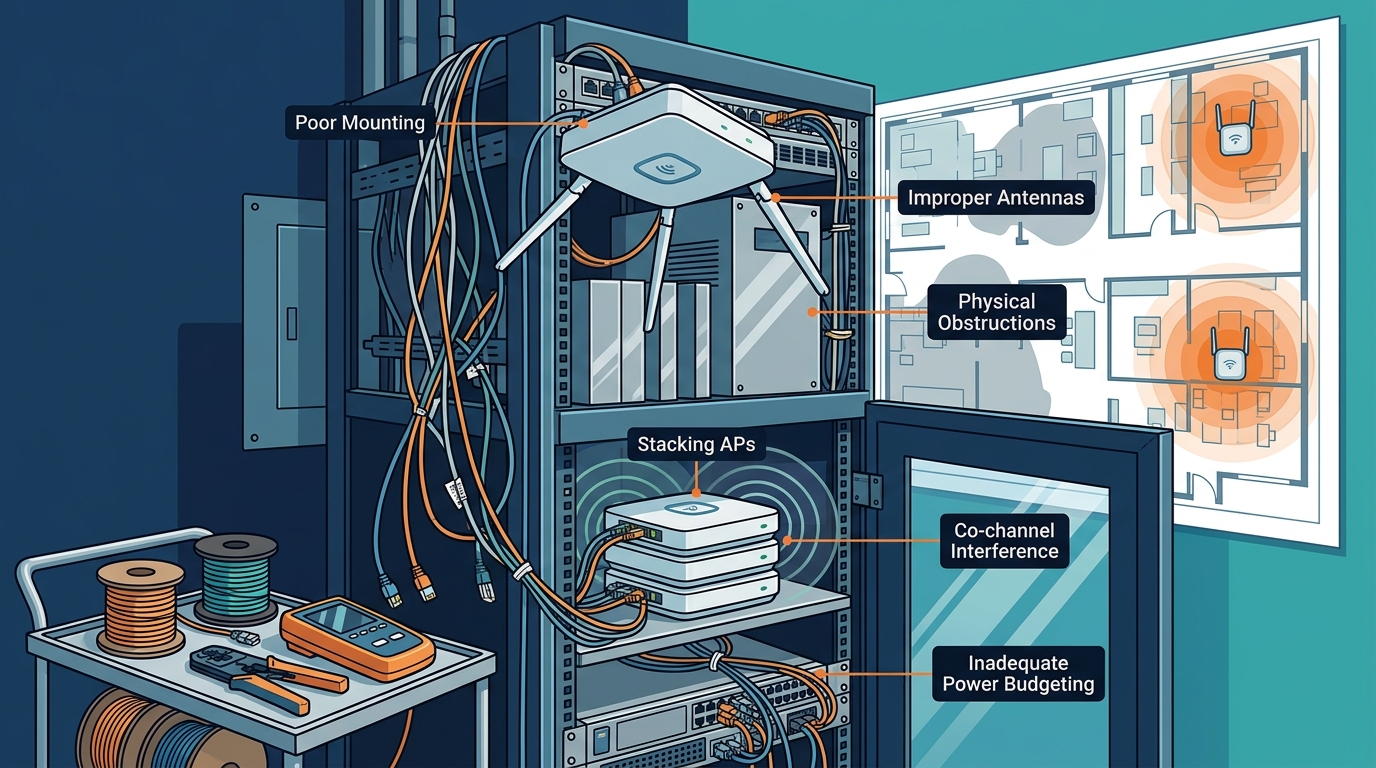
The most critical error in Wi-Fi deployment is assuming that the floor plan matches the physical reality. Buildings are filled with dense materials like concrete, steel, and glass that attenuate radio frequency signals. Without a professional site survey, you are guessing where access points should go. This leads to dead zones and weak signal areas that frustrate employees.
A professional site survey involves using specialized tools to map signal strength and quality throughout the facility. Moore Technology specializes in designing and installing comprehensive commercial communication systems. We use predictive modeling and on-site validation to ensure every square foot of your office has adequate coverage. This process identifies physical obstacles that software alone cannot predict. By investing in a thorough survey, you avoid the costly mistake of installing hardware in the wrong locations.
When you skip this step, you risk having to pull cables and reinstall access points later. This doubles your labor costs and extends the deployment timeline significantly. A proper survey ensures that your initial investment delivers the performance you need from day one.
Mistake 2: Ignoring RF Environment and Channel Planning
Wi-Fi operates in unlicensed spectrum bands, which means your network competes with neighboring networks, Bluetooth devices, and microwave ovens. Many IT managers make the mistake of leaving channel selection to automatic algorithms. These algorithms often fail in dense environments, causing interference and reduced throughput.
Proper channel planning involves assigning non-overlapping channels to adjacent access points. For example, in the 2.4 GHz band, only channels 1, 6, and 11 do not overlap. In the 5 GHz band, there are more options, but careful planning is still required to avoid co-channel interference. Moore Technology ensures that every network installation is optimized for the specific RF environment of the building.
We also consider the density of devices in each area. A conference room with twenty laptops requires different channel planning than a quiet office with a single desktop. Ignoring these nuances leads to a network that works well in empty offices but collapses during peak usage times. Proper planning ensures consistent performance regardless of how many devices are connected.
Mistake 3: Underestimating Bandwidth and Latency Requirements
Business applications have evolved. Video conferencing, cloud computing, and large file transfers require significant bandwidth and low latency. A common mistake is sizing the internet connection and internal network infrastructure based on past usage rather than future needs. This leads to bottlenecks when employees try to collaborate in real-time.
According to network performance benchmarks, latency above 100ms degrades video call quality significantly. If your Wi-Fi network cannot handle the load, your employees will experience lag, dropped calls, and slow application response times. Moore Technology provides expert installation of structured cabling solutions, such as ethernet, fiber optic, and WiFi networks, ensuring seamless communication infrastructure tailored to your business needs.
We help you calculate the required bandwidth based on the number of users and the types of applications they use. This includes accounting for peak usage times and growth projections. By overestimating rather than underestimating, you ensure that your network can handle sudden spikes in demand without breaking down.
Mistake 4: Neglecting Network Segmentation and Security
Connecting all devices to a single network is a major security risk. Guest devices, IoT sensors, and employee laptops should never share the same network segment. If a guest device is compromised, it can potentially access sensitive corporate data. This is a critical mistake that exposes your business to cyber threats.
Network segmentation involves creating separate virtual LANs (VLANs) for different types of traffic. For example, you might have one VLAN for employees, one for guests, and one for security cameras. Moore Technology specializes in designing and installing comprehensive commercial communication and security systems. Our approach ensures that your access control, burglar alarms, and security cameras are integrated securely without compromising the main business network.
We also implement robust authentication protocols, such as WPA3-Enterprise, to ensure that only authorized devices can connect. This prevents unauthorized access and protects your data from external threats. By prioritizing security from the start, you avoid the nightmare of a data breach and the associated regulatory fines.
Mistake 5: Failing to Implement Proactive Monitoring
Many businesses deploy their Wi-Fi and then forget about it until something breaks. This reactive approach is inefficient and costly. Without proactive monitoring, you cannot identify potential issues before they impact your employees. You might not know that an access point is failing until your team complains about slow speeds.
Proactive monitoring involves using network management tools to track performance metrics in real-time. These tools can alert you to high interference, failed authentication attempts, or hardware failures. Moore Technology offers all-inclusive, white-glove managed IT services tailored to businesses. Our managed IT services include continuous monitoring and maintenance to ensure your network is always running at peak performance.
We provide prompt resolution for any issues that arise. Our technicians are fully mobile, ensuring flexibility in service delivery. After-hours and emergency technical support are available to our customers in accordance with the terms outlined in our service level agreement. This proactive approach minimizes downtime and keeps your business running smoothly.
Key Takeaways
- Professional Site Surveys are Essential: Never rely on floor plans alone. Use predictive modeling and on-site validation to ensure complete coverage.
- Channel Planning Prevents Interference: Manually assign non-overlapping channels to avoid co-channel interference in dense environments.
- Size for Future Growth: Underestimating bandwidth leads to bottlenecks. Plan for peak usage and future application demands.
- Segment Your Network: Separate guest, employee, and IoT traffic to enhance security and performance.
- Implement Proactive Monitoring: Use managed IT services to detect and resolve issues before they impact productivity.
- Moore Technology’s Expertise: With over a decade of experience, we specialize in complex commercial installations across Montana, Texas, and Colorado.
- Quality Control is Non-Negotiable: Our "Is this your best work?" standard ensures integrity in every cable pulled and configuration made.
Frequently Asked Questions
How long does a professional Wi-Fi site survey take?
The duration depends on the size and complexity of the facility. A small office might take a few hours, while a large industrial campus could take several days. Moore Technology ensures thorough coverage by combining predictive modeling with on-site validation.
What is the difference between managed Wi-Fi and standard Wi-Fi?
Managed Wi-Fi includes ongoing monitoring, maintenance, and support from a dedicated team. Standard Wi-Fi is typically a one-time installation with no ongoing support. Moore Technology provides white-glove managed IT services to ensure your network remains secure and efficient.
Can Moore Technology support multi-site deployments?
Yes. We specialize in single-site, multi-site, and route-specific deployments. Our team has experience managing networks across Montana, Texas, and Colorado, ensuring consistent performance across all locations.
How does network segmentation improve security?
Network segmentation isolates different types of traffic, such as guest devices and employee laptops. This prevents a compromised guest device from accessing sensitive corporate data, reducing the risk of cyber attacks.
What types of businesses do you serve?
We serve a wide range of commercial and industrial businesses, including retail, healthcare, education, and corporate offices. Our services include access control, intrusion alarms, and structured cabling tailored to each industry’s unique needs.
Do you offer after-hours support?
Yes. We offer after-hours and emergency repairs subject to a service-level agreement. Our mobile technicians can respond quickly to ensure minimal downtime for your business.
What is your approach to quality control?
We operate by the standard, "Is this your best work?" This ensures that every technician takes personal pride in their work, from cable pulling to configuration. We do not cut corners, ensuring long-term reliability.
Ready to Optimize Your Network?
Don’t let Wi-Fi issues hold your business back. Moore Technology is your trusted partner for complete IT support and cyber security. We provide tailored solutions that enhance safety, connectivity, and operational efficiency. Contact us today to schedule a consultation and discover how we can transform your network infrastructure.
Contact Moore Technology to get started.