

Centralized security maintenance consolidates oversight into a single command center, while decentralized maintenance distributes control to local teams. For businesses operating across multiple sites, this choice dictates response times, policy consistency, and operational agility. Moore Technology and Security helps organizations navigate this decision by aligning maintenance structures with specific site conditions and business goals. For additional details, review the mooretech biz.
Defining the Operational Models
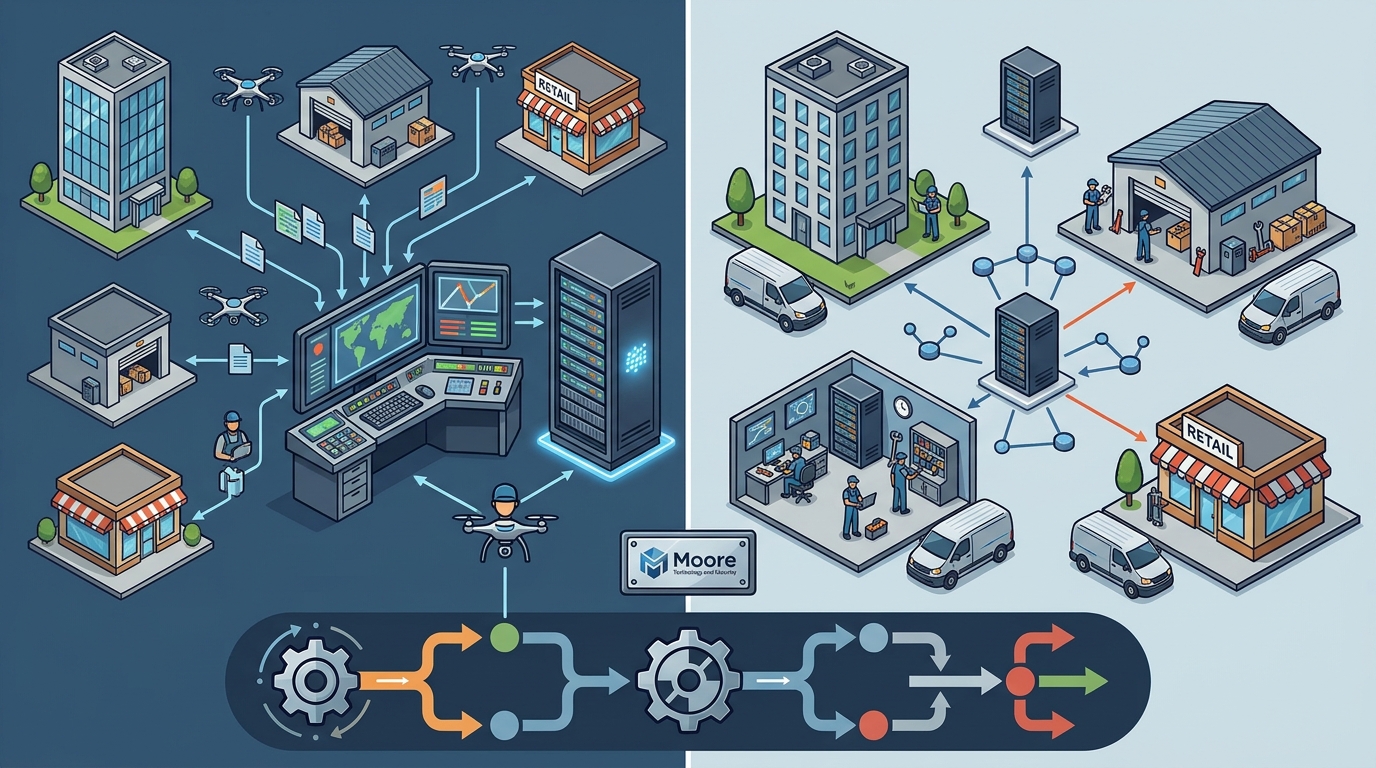
Centralized security maintenance is a model where a single, unified team manages all security systems, policies, and monitoring for an organization. This approach typically relies on a central operations center that oversees cameras, access control, and network security across all locations. The primary advantage is uniformity. When one team handles everything, policy enforcement remains consistent. A rule set for password complexity or camera retention periods applies identically to every branch. This reduces the risk of configuration drift, where one site might have outdated settings while another is current. For additional details, review the Customer Experience.
Decentralized security maintenance is a model where local site managers or regional teams handle the day-to-day upkeep of their specific security infrastructure. In this structure, each location has autonomy over its systems. Local technicians respond to alarms, update access lists, and troubleshoot network issues on-site. This model excels in environments where local context matters more than global uniformity. For example, a factory floor might require different camera angles than a corporate office, and local staff can adjust these settings without waiting for central approval. according to How should security For additional details, review the Frequently Asked Questions.
Understanding these definitions is the first step in evaluating your needs. The choice is not binary; many organizations use a hybrid approach. However, the core tension remains between consistency and speed. Centralization favors consistency, while decentralization favors speed and local adaptability. For additional details, review the About.
Policy Consistency and Reporting
Centralization usually improves policy consistency and reporting, while decentralization can help teams move faster in distributed environments. When security teams choose between these models, they must consider how they handle data. In a centralized model, all logs, alerts, and performance metrics flow to a single repository. This makes it easier to generate organization-wide reports. Auditors can see a complete picture of security events across all sites in one dashboard. This is critical for compliance and risk management. If a breach occurs, the central team can trace the attack path across multiple locations quickly.
In contrast, decentralized models often struggle with data aggregation. Each site may use different tools or formats for logging. Consolidating this data for a single report can be time-consuming and error-prone. However, decentralized teams can respond to local incidents faster. If a door sensor fails at a specific warehouse, the local technician can fix it immediately. They do not need to wait for a ticket to be routed through a central queue. This speed is valuable for maintaining physical security. A broken sensor is a vulnerability, and local autonomy allows for rapid remediation.
Response Times and Local Autonomy
However, this autonomy comes with risks. Without central oversight, local teams might make inconsistent decisions. One site might lock down during a minor alarm, while another ignores it. This inconsistency can confuse employees and customers. It can also lead to security gaps if local teams lack the expertise to handle complex threats. Centralized teams, on the other hand, bring standardized expertise. They are trained to handle a wide range of scenarios. They can apply best practices uniformly. This reduces the likelihood of human error in critical situations.
For businesses with multiple locations, the ideal approach often involves a hybrid strategy. Critical physical security actions are handled locally for speed. Strategic policy changes and complex cyber threats are managed centrally for consistency. Moore Technology and Security designs maintenance plans that reflect this balance. We ensure that local teams have the tools and authority to act quickly, while central oversight ensures that all actions align with broader security goals.
Scalability and Interoperability
Interoperability, scalability, and security are key factors that both centralized and decentralized models strive to meet. As a business grows, adding new locations becomes a test of your maintenance model. In a centralized system, adding a new site is often straightforward. You connect the new site to the existing central platform. The same policies and monitoring rules apply automatically. This makes scaling easier. You do not need to train a new local team or configure new tools. The central team simply adds the new site to their dashboard.
In a decentralized model, scaling can be more complex. Each new site requires its own local team or technician. You must ensure that these local teams are trained and equipped. You must also ensure that their systems can communicate with each other if needed. This can lead to fragmentation. Different sites might use different brands of cameras or access control systems. Integrating these disparate systems can be difficult. It can create silos where data does not flow freely. This fragmentation can hinder long-term scalability.
Centralized digital identity systems heavily rely on a combination of security measures that safeguard user data and provide a robust defense against potential breaches. This principle applies to physical security as well. Centralized systems often have stronger security controls. They can enforce multi-factor authentication and encryption across all sites. Decentralized systems may have weaker security if local teams are not disciplined. They might use weak passwords or outdated firmware. This increases the risk of breaches. To mitigate this, decentralized models need strong central governance. They need clear standards and regular audits. Without this, the speed of decentralization can come at the cost of security.
Choosing the Right Model for Your Business
Selecting the right maintenance model depends on your specific business needs. There is no one-size-fits-all solution. You must evaluate your industry, location, and risk tolerance. If you operate in a highly regulated industry, centralization may be required. Regulators often demand uniform controls and comprehensive reporting. If you operate in a dynamic, fast-paced environment, decentralization may be more suitable. You need the ability to adapt quickly to local conditions.
Key Takeaways
- Decentralized maintenance provides faster local response times and greater operational autonomy.
- Centralization reduces the risk of configuration drift and ensures consistent security standards.
- Decentralization can lead to data fragmentation and inconsistent decision-making without strong governance.
- Scalability is often easier in centralized models, as new sites can be added to an existing platform.
- A hybrid approach often provides the best balance of speed and consistency for multi-site businesses.
- The choice between models should be based on industry regulations, risk tolerance, and operational needs. according to Navigating Data Governance
Frequently Asked Questions
What is the main advantage of centralized security maintenance?
The main advantage is policy consistency. A single team ensures that all sites follow the same security rules, which simplifies reporting and reduces the risk of configuration errors.
How does decentralized maintenance improve response times?
Decentralized maintenance allows local teams to act immediately on security issues. They do not need to wait for approval from a central command center, which can speed up the resolution of physical security threats.
Can a business use both centralized and decentralized models?
Yes, many businesses use a hybrid model. Critical local actions are handled by decentralized teams for speed, while strategic policies and complex threats are managed centrally for consistency.
Which model is better for regulated industries?
Centralized models are often better for regulated industries. They provide the uniform controls and comprehensive reporting that regulators typically require. according to Comparing Centralized Versus
How does Moore Technology and Security help with this decision?
Moore Technology and Security assesses your specific business needs, infrastructure, and risk profile. We then recommend a maintenance model that best fits your operational goals.
What are the risks of decentralized maintenance?
The main risks are inconsistency and data fragmentation. Without strong central governance, local teams may make different decisions, and data may be difficult to aggregate for reporting.
Conclusion
To discuss your specific maintenance needs, contact Moore Technology and Security. Learn more: mooretech biz.